

The first production client project the TalkIDE team delivered start to finish, brief to working app.
TrainVR.pro builds VR training experiences. They had a prospect meeting coming up and needed a clickable proof of concept to walk through with them: an e-learning system where the content lives in VR. They described it in a single paragraph. One person, plain language, no tickets and no Jira.
That was at 10:12 in the evening. By 11:49, the admin was logged into a working application.
The brief
The request was straightforward. Instructors build courses and assign them to students. Trainees consume lessons through a VR client. Member management was in scope as a POC, with a shared static password keeping things simple for the demo. That was the whole brief.
What it implied was a three-layer content model: Trainings as top-level programs, Lessons as VR content units inside a training (each carrying on-screen text, an AI avatar with a personality prompt, media of various types, a linked media stream, and a geosync flag), and Streams as named media stream links that lessons play. Lessons are ordered by position. Trainees see only the trainings assigned to them.
The team
You talk to one person. She runs the rest.
Mara is the product manager and the single point of contact. She ran discovery, locked scope, and kept the work moving. Iris, the business analyst, turned the brief into a real specification before any code was written. Theo handled the backend: data model, API, auth, tests. Eli built both web surfaces. Nia reviewed both sides independently against the spec. Kai handled build and deploy.
Six agents. One conversation.
What got built
For TrainVR.pro, the scope is a JWT-secured role-based REST API: 7 feature groups, 25 endpoints, 5 database tables, with two roles enforced throughout. Admins manage members, trainings and streams. Trainees see only what’s assigned to them.
The backend is a JWT-secured role-based REST API across seven feature groups and 25 endpoints, backed by five database tables with seed data. Auth covers login, current user, and logout. Members have full CRUD, with the shared POC password set automatically. Streams have full CRUD. Trainings have CRUD plus a detail view with embedded lessons. Lessons have CRUD plus a dedicated reorder endpoint. Assignments handle the many-to-many join between trainings and trainees: list, add, remove. The trainee portal API exposes my-trainings list, training detail, and lesson view, all gated by assignment.
The frontend is two fully internationalized web surfaces. The admin panel covers members, trainings, a training detail screen with drag-to-reorder lessons and an assignees tab, and streams. The trainee portal has a “My Trainings” list that leads into training detail and the VR lesson view.
The lesson view renders each media type (video, YouTube, TikTok, image), the avatar text and its personality prompt, the linked stream, and the geosync flag. The /me/* endpoints are clean JSON, ready for the actual VR client to consume directly.
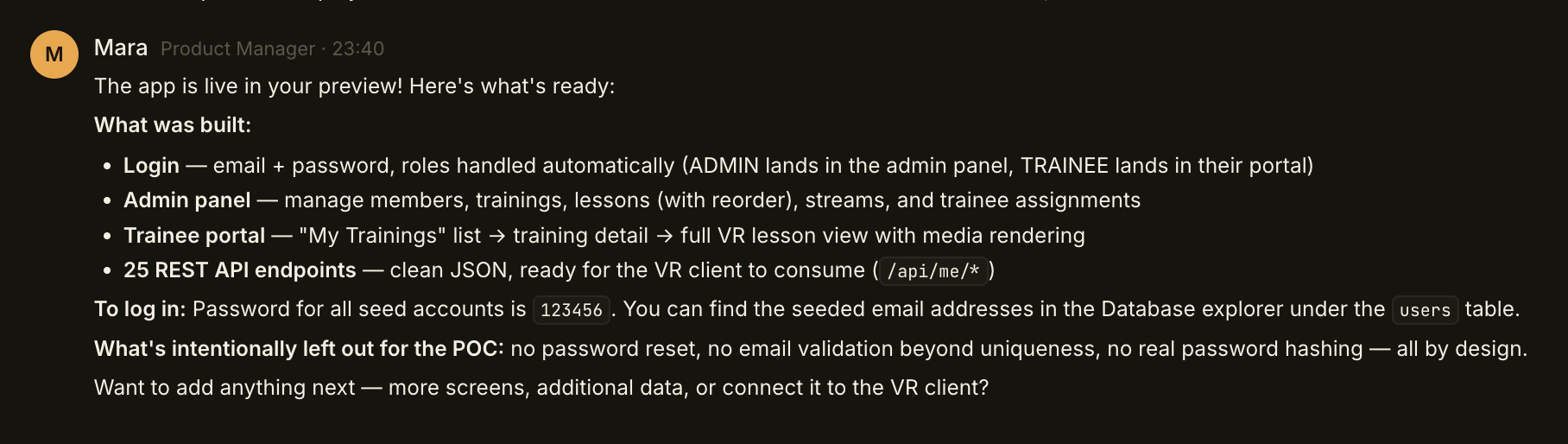
Mara’s handover at the end of the build: what shipped, how to log in, and what was deliberately left out for the POC.
The part that proves it is a team
The timeline compresses a full software lifecycle into an evening, but the shape of the work is what matters.
Discovery happened before building. Mara asked the two architecture-defining questions instead of guessing, then locked scope. The spec contained real decisions. Iris produced an entity model, 25 use cases, and two ADRs that recorded the why, not just the what. An independent review failed the first attempt. Nia returned specific fix lists for both sides, and the team caught its own gaps before deploy. A live bug was diagnosed and fixed. The login threw a 500 in the running app. The team read the logs, found the double /api path, and fixed and redeployed without the user touching anything.
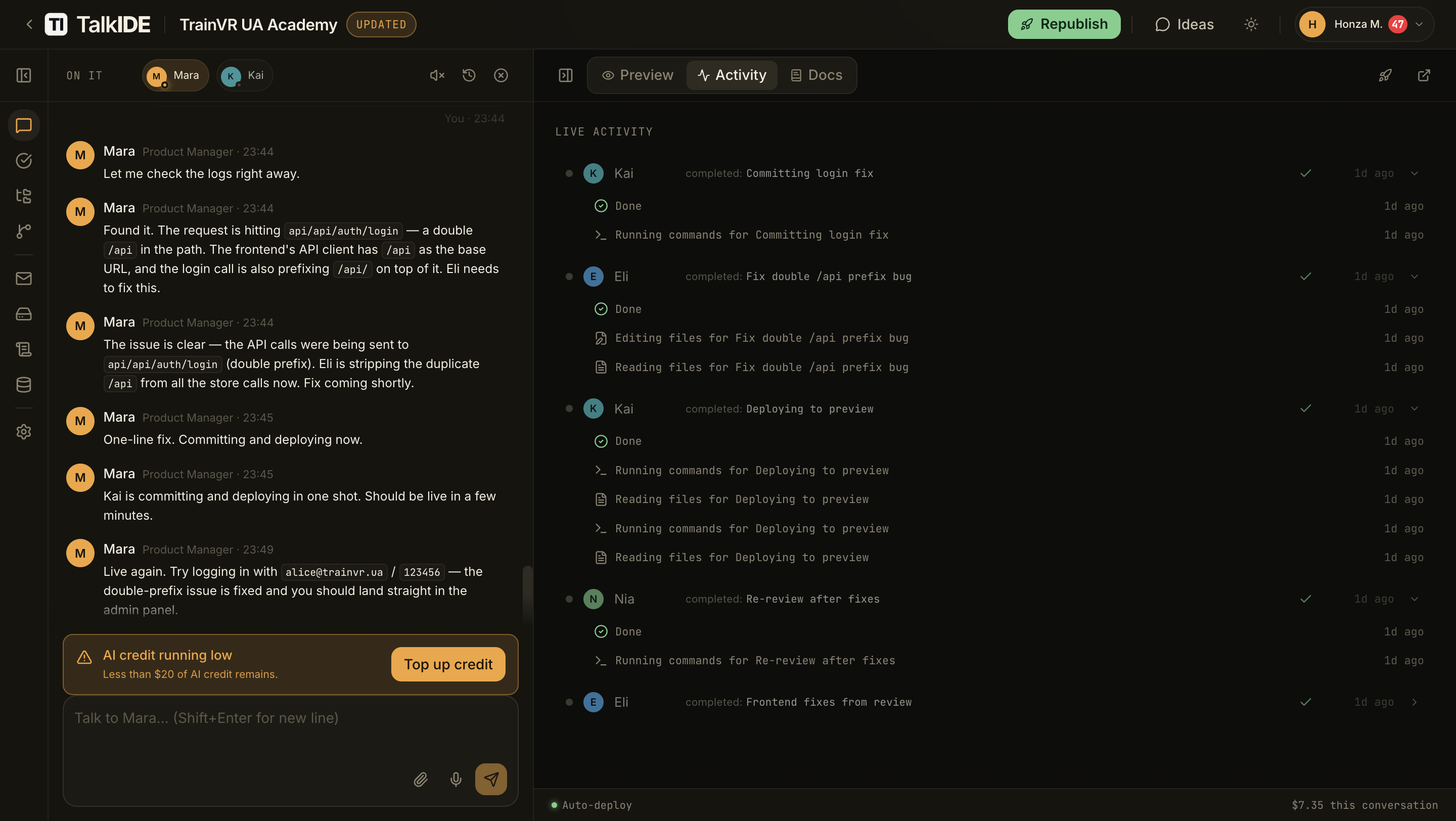
The team’s commit, fix, and deploy activity visible in the live feed: Kai’s login fix, Eli’s double /api patch, and the redeploy to preview.
Discovery to spec to parallel build to QA to fix to deploy to hotfix. That is what an experienced team does.
A note on scope
This was built as a proof of concept for a prospect demo, and it is honest about that. Every member shares a static password stored in plain text. That is not an oversight. It is a deliberate decision for a demo build, documented in an ADR that flagged production hardening (real password hashing, password reset, stronger email validation) as required.
TrainVR.pro went into production client use without that hardening being completed, and the shared plaintext password remains in place today. The ADR documented a tradeoff for the demo build, not a step that was later completed.
A POC that hides its tradeoffs is a liability. One that documents them is a foundation the production build can stand on.
What this means
Most AI app builders hand you a tool and leave the engineering judgment to you. TalkIDE hands you a team that carries the work the way a senior team would: asks the right questions up front, writes down its decisions, reviews its own output, and fixes what breaks.
This was the first production client project taken from a blank brief to a working deployable application entirely on TalkIDE. TrainVR.pro got a clickable VR training platform to walk their prospect through the same evening they described it: a complete admin experience, a trainee portal, an API ready for the VR client, and the engineering artifacts to back all of it.
1 hour 37 minutes. Brief to working app.
If you are curious what that looks like for your next project, start at talkide.app.
TalkIDE is open. No invite, no waitlist. Sign up at talkide.app. New accounts get $10 in credits.